


©YesICannes.com
The competition at the 2026 Cannes Film Festival continues on the Croisette with two stunning films: Paweł Pawlikowski’s Fatherland and Asghar Farhadi’s Parallel Tales.
Parallel Tales : The race for the Palme d’Or is now in full swing. Following the acclaim of Ida in 2013 and a Best Director award for Cold War in 2018, Polish director and screenwriter Paweł Pawlikowski returns on the Croisette with Fatherland, taking us into a torn post-WWII Germany as Europe heals its wounds betwwen Americans and Russians. Meanwhile, returning to Cannes after A Hero (2021), Iranian screenwriter, director, and producer Asghar Farhadi has chosen to freely adapt an episode of Krzysztof Kieślowski’s Dekalog for his film Parallel Tales.
©Agata Grzybowska
Paweł Pawlikowski’s Fatherland
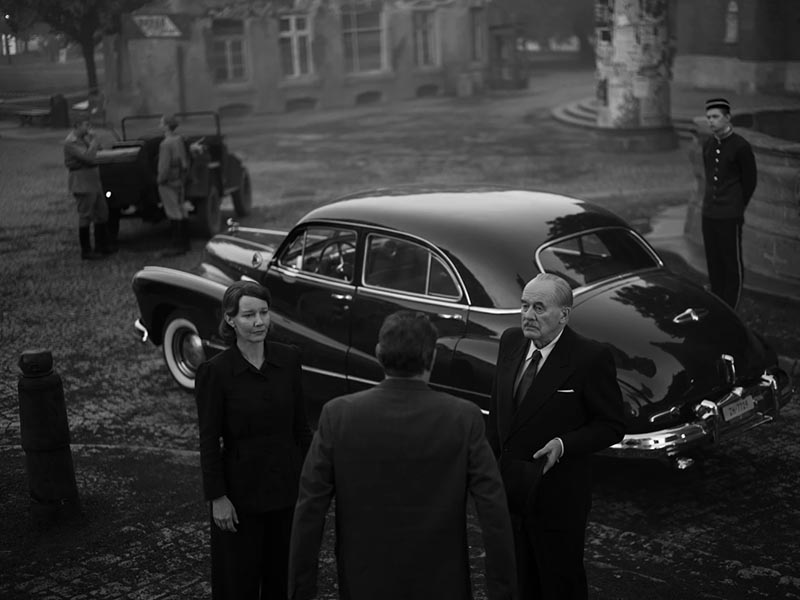
Eight years after receiving the Best Director award for Cold War at the Cannes Film Festival, Paweł Pawlikowski returns to the Official Competition with Fatherland, a twilight work that confirms his obsession with the invisible borders of Europe and memory. Captured in austerely splendid black and white by cinematographer Łukasz Żal, the film follows Thomas Mann’s return to Germany in 1949, accompanied by his daughter Erika. Aboard an imposing black Buick, father and daughter traverse a country shattered by war and already fractured by the first tremors of the Cold War. For Pawlikowski, however, the geographical journey is secondary to the internal upheaval: every city they cross reflects a still-smoldering European guilt.
©Agata Grzybowska
History’s Poisoned Legacies
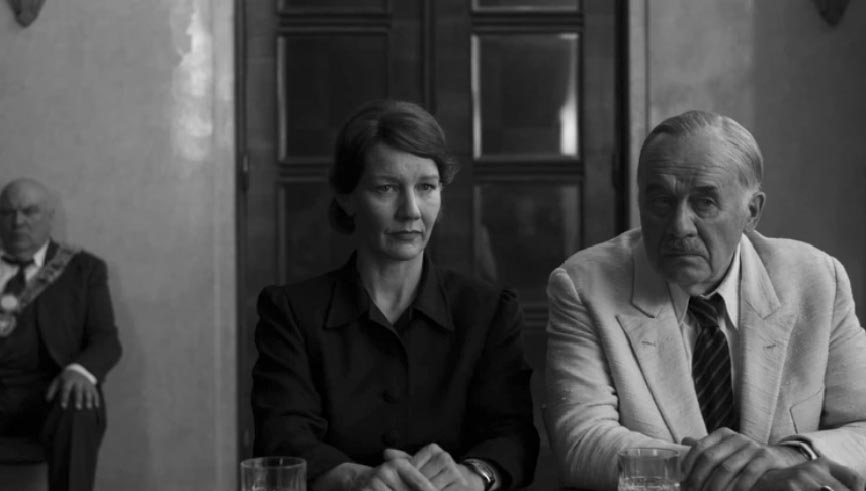
Far from a simple historical biopic, Fatherland unfolds as an elegiac meditation on exile and disillusionment. Sandra Hüller brings a quiet, almost spectral intensity to the film, while Hanns Zischler embodies an intellectual Germany haunted by its own moral ruins. True to the minimalism that defined Ida, Paweł Pawlikowski rejects didacticism, choosing instead to film silences, gazes lost in destroyed landscapes, and conversations suspended in post-war cafés. In Cannes, Fatherland stands out as a work of great formal elegance and a profoundly contemporary interrogation of the poisoned legacies of European history.

Isabelle Huppert ©YesICannes.com
Asghar Farhadi’s Parallel Tales
With Parallel Tales, Asghar Farhadi delivers perhaps his most dizzying work since A Separation. Set in a Paris devoid of clichés or postcards, the director transforms a few apartments on Boulevard Saint-Martin into a fascinating mental theater where fiction progressively contaminates reality. Sylvie, a novelist played by Isabelle Huppert, observes her neighbors like one constructs a novel: through fragments, intuitions, and projections. When she hires Adam, a mysterious young man played by Adam Bessa, the narrative balance gradually shifts, blurring the line between imagination and lived experience. True to his penchant for nested narratives, Farhadi orchestrates an emotional labyrinth where every look, silence, and sound seems to hide another story.

©Carole Bethuel
Prisoners of Their Own Mental Constructions
Freely inspired by the sixth episode of the Dekalog, the film pays tribute to the Polish master’s universe without ever lapsing into nostalgic imitation. More than imagery, it is sound that becomes dramatic material here: the characters being spied upon are foley artists, capable of artificially manufacturing reality from simple gestures recorded in a studio. This concept permeates the entire film. The roar of rain, a breath behind a door, a voice heard through a partition—these become narrative elements as powerful as the dialogue itself. Farhadi, citing the influence of Krzysztof Kieślowski, Robert Bresson, and Theo Angelopoulos, composes a sensory film of rare sophistication, where the off-screen soundscape reveals the intimate anxieties of characters trapped in their own mental constructions.

©Carole Bethuel
A Cerebral but Profoundly Sensual Work
Surrounding Isabelle Huppert, the French cast impresses with its precision and constant sense of unease. Vincent Cassel, Pierre Niney, and Virginie Efira play dual characters – real and fictional – in a fascinating hall of mirrors where identities constantly slip away. Farhadi has rarely pushed his reflection on storytelling and the strange violence inherent to artists – feeding off the lives of others to create – this far. A hybrid of psychological thriller, a reflection on cinema, and a meditation on the desire to invent, Parallel Tales establishes itself in Cannes as a cerebral yet profoundly sensual work, carried by hypnotic and fluid direction.

©YesICannes.com

©YesICannes.com

©YesICannes.com

©YesICannes.com
The “Montée des Marches” (Red Carpet) for Parallel Tales
Click to enlarge – ©YesICannes.com – All rights reserved















Recent Comments