

©DR
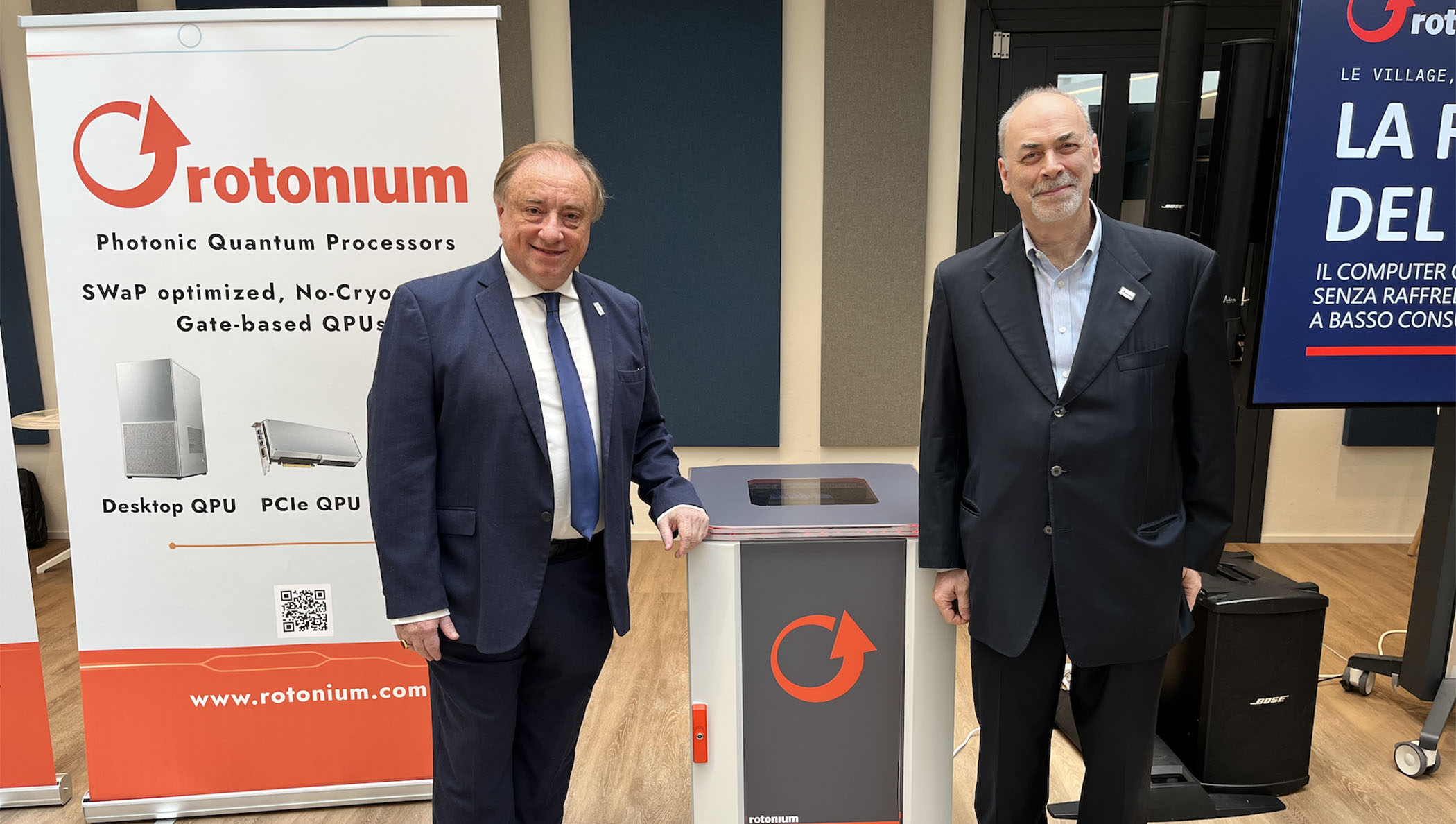
At the World Quantum Cannes Festival, Rotonium presented a room-temperature quantum computer that aims to bring the quantum revolution out of the laboratory.

©DR
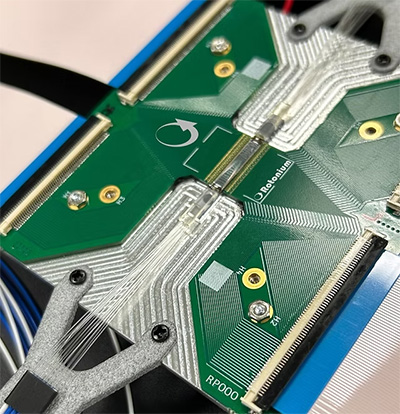
Rotonium : At the World Quantum Cannes Festival, Italian deep-tech startup Rotonium unveiled a prototype photonic quantum computer capable of operating entirely at room temperature, without any cryogenic cooling across its entire processing chain. The announcement from the Italian startup centers on breaking away from one of the heaviest constraints in quantum computing: cooling processors to temperatures near absolute zero. Based in Padua, Italy, Rotonium showcased a prototype photonic quantum computer operating completely at room temperature, with no cryogenics anywhere in the processing chain. With four effective qubits integrated onto a chip measuring just 18 × 4 millimeters, the company aims to pave the way for compact processors capable of being embedded into industrial equipment, robots, autonomous vehicles, and satellites.

Fabrizio Tamburini ©DR
Using Light to Break Free from the Cold
Founded in 2022 by Roberto Siagri and Fabrizio Tamburini, Rotonium relies on photons – the elementary particles of light – to process quantum information. Its technology exploits different physical properties of a single photon, known as degrees of freedom, notably orbital angular momentum, to encode and manipulate multiple qubits within the same particle. Unlike superconducting architectures that require extremely low temperatures, the prototype operates at room temperature from the source generating the photons through the processor to the detectors reading the results. The chip presented at the World Quantum Cannes Festival houses four effective qubits—meaning qubits that can be used together in a verified computation under the test conditions defined by the company. This compact photonic architecture represents a first step toward processors that can be integrated into conventional electronic systems.

Roberto Siagri ©DR
Quantum Computing at the Heart of Industrial Equipment
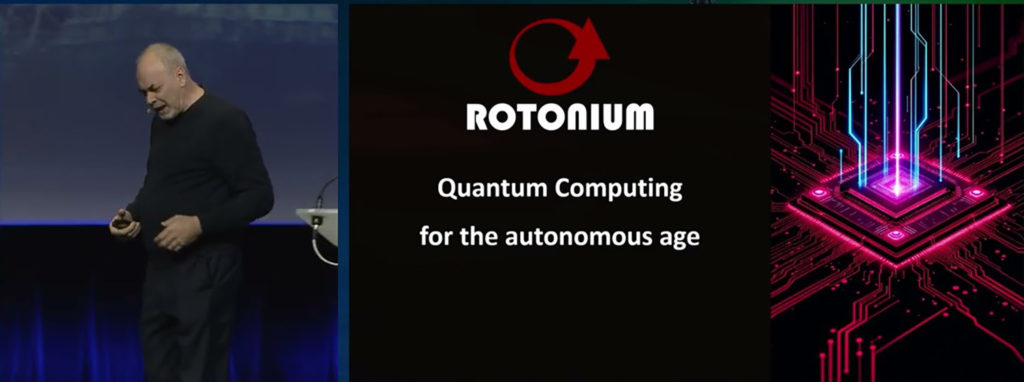
For Roberto Siagri, CEO and co-founder of Rotonium, the challenge is not merely increasing the number of qubits, but making this computing power genuinely usable. He champions the concept of “Industrial Quantum Utility,” grounded in a balance between performance, footprint, weight, energy consumption, cost, and ease of deployment. This approach notably targets edge quantum computing: accelerators integrated directly into the equipment that generates and uses data. Envisioned applications include onboard artificial intelligence, route and trajectory optimization, image analysis in low-light conditions, and interpreting data from quantum sensors. Robots, autonomous vehicles, and satellites are among the primary target environments, where size and power availability are particularly restrictive. Longer term, Rotonium envisions a quantum-enhanced Internet of Things, combining sensors, computing, and communications within a single ecosystem.
©DR
Error Management and Industrialization
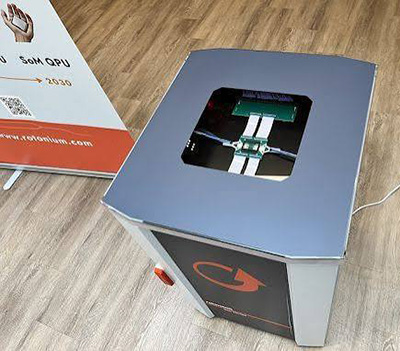
Reliability remains one of the major challenges of quantum computing. Rotonium states that it has developed a proprietary architecture designed to limit computational errors while reducing system complexity. Its technology is backed by six patent families, resulting in 25 patent applications, six of which have already been granted. The company also favors manufacturing processes compatible with silicon photonics – a direction that could facilitate larger-scale production and the integration of its processors into existing electronic equipment. Rotonium’s announced roadmap outlines a gradual ramp-up in capacity. Following the current prototype, the startup is targeting a 16-effective-qubit desktop tower system in 2028, followed by a 32-qubit accelerator on a PCI Express card in 2029. In 2030, it plans to develop a System-on-Module directly integrable into hardware.

©DR
From Four to 96 Effective Qubits by 2030
The industrial goal is to reach 96 effective qubits in 2030, and several thousand by 2035. These milestones remain development targets that will need to be validated at each successive stage. Integrating these accelerators into data centers dedicated to artificial intelligence is also under consideration. By offloading specific operations to the quantum processor, Rotonium hopes to help reduce the energy demands of certain workloads—an advantage that will nevertheless need to be verified depending on the application and overall system consumption.
©DR
Rotonium Aims to Democratize Access to Quantum
To support its technological development, processor miniaturization, and transition toward industrialization, Rotonium has launched a Series A funding round. Its ambition is to steer quantum computing toward more compact, reliable, and accessible components that can be deployed as close as possible to industrial needs. “We want to help democratize access to quantum computing, turning it into a tool that can be used in industrial settings and electronic systems,” sums up Roberto Siagri. With its room-temperature photonic prototype, the young Italian company is exploring a promising path: moving quantum computing out of specialized facilities to progressively integrate it into everyday technologies. The true revolution may not lie solely in the sheer power of future quantum computers, but in their ability to become concrete industrial tools.

Rotanium ©DR













Recent Comments